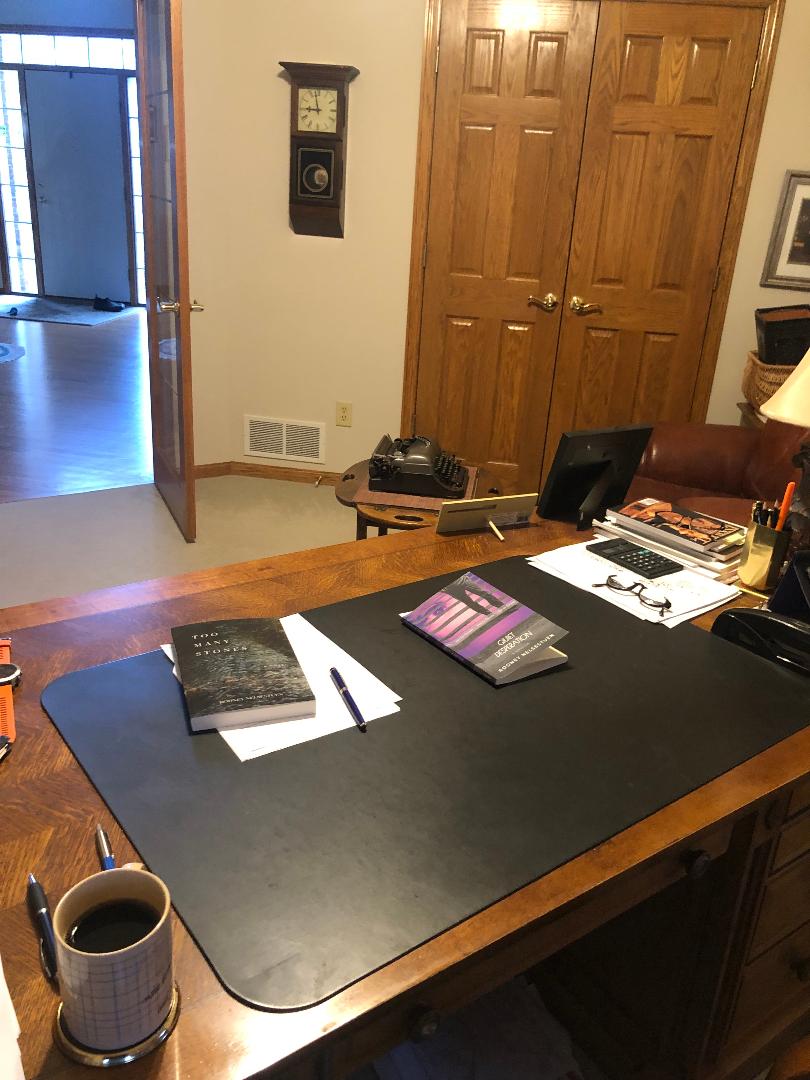
I took this book up in response to having read Lerner’s short novella Transcription.
A celebrated writer, Lerner’s jumping around and losing the theme and later maybe finding it again is being hailed as the new standard for the novel. Transcription has a long section about a young girl’s unwillingness to eat and her parents’ concern and attempts to get her to eat, but then when time passes and she gets older, she starts to eat. It is unrelated to the actual content of much of the rest of the novel.
That was an element of maybe the ‘everyday’ more writers are including in the novel (read something by Karl Ove Knausgård for further evidence,) and such events may not be tied to the plot at all. That’s not the case with Lerner’s The Topeka School, however. He does stay with the plot but the plot is a series of individual, internalized sections of the book where a main character evokes his or her opinion on others and what’s going on, then stops and starts a new section with a different main character doing the same thing. We go back and forth – zig zagging – between characters and we stay largely internal. At least there is a common timeline of moving forward if only because we see the internalizations of teenage Adam grow into the internalizations of Adam as a man and a father. But then the actual place, the Topeka School, is a Foundation where psychologists, psychiatrists, sociologists, anthropologists, and others of ‘ist’ ilk hone their theories on humankind, humanity, and humans individually. So I get the internalization of the novel as a whole. And with any internalized narrative, the thinker (point of view character) may not always stay laser-focused on a given topic since in internal thinking, right in the middle of an extremely key point one might.. “Oh! Look! A squirrel.”
I, of course, will be judged thick headed and ignorant, if not stupid, for calling some of this out as the king’s new clothes. One example: in the cover introduction to the book it says Lerner is “deftly shifting perspectives and time periods.” This is a true statement except IMHO, for the word “deftly.” There is deft, but there are also times when one has to re-find one’s place in the story.
The boy-Adam becomes the man-Adam with a child of his own. A celebrated poet, he returns from New York to Topeka to do a reading of his poetry and of course one can imagine the ghosts of his past revisiting him as he does so. We see that only briefly and we don’t find out how that reading went which in my view is sad because it’s a rich place to mine. Maybe the reading was immaterial. But suddenly we find ourselves in New York with Adam and his wife and small child taking part in an anti-ICE demonstration. Then the book ends. Stream of consciousness? Or is this someone in need of counseling?
One theory I have is that the structuring of novels today is ripe for study groups and an accompanying study guide. Whether it’s young Kaveh Akbar zooming between decades and often without warning (see my comments on his book Martyr!) or the hugely internalized one-sentence-in-seven-books Septology by Jon Fosse, or Knausgård’s 6 volume, 1.3+ million words in nearly 3,800 pages of his not so originally named My Struggle, experimentation and rule breaking is rampant.
Here we must throw in the east European novelists such as László Krasznahorkai who also write books without an arc, and also in one sentence. Ok, I admit that even Marquez got close to a single sentence in some of his writing (The Autumn of the Patriarch) and Isabel Allende’s The Infinite Plan, which does away with most punctuation, (From a google search 6 Books That Are Written As One Long Sentence | Times Now) are earlier examples of what has now grown into devil-may-care-the-outcome as long as it’s different for which it will be praised.
So I believe there are no rules anymore as far as the novel genre is concerned. Hence, get a study guide written by some graduate student whose thesis/dissertation takes on one of these tomes.
But maybe in this growing confusion of genre-bending writing, something new and lasting will emerge, something less extreme than the leading extremist novelists of today. I return to Samantha Harvey’s largely internal book Orbital, which is literary genius that doesn’t scream at you ‘Hey, hey you! I write differently. Do you see that? I write like no one else and don’t tell me I don’t.”
I’m becoming more interested in what judges of books in contests are now saying about such techniques, which, in the past, were entirely viewed as poor writing and were immediately tossed out of contention. In my own judging work, I give sway to such innovations, but only if the book meets other criteria such as presenting a ‘whole’ at the end of the day, and the quality of prose and other more traditional aspects of judging the novel. That is, I look for the traditional aspects, but also, when confronted with something well out of bounds, don’t immediately berate it. If the innovation in some form contributes to the artistic experience of the novel, I count it good. In short, the innovation has to mean something.
One more point before turning positive on the trends of the novel as genre. George Saunders novel Lincoln in the Bardo was named one of the best novels of this century – so far. He’s completed a new novel entitled Vigil. In Bardo, we gather at president Lincoln’s son’s entombment along with a series of ghosts and specters that provide teachable moments and insights to humanity. I read Bardo some time ago and found it was a bit confusing, but critics cited it as (once again) genius. In Vigil Saunders follows the same formula as pronounced in the review by The Economist magazine (https://www.economist.com/culture/2026/01/29/what-are-novels-for-george-saunders-has-answers) where Saunders says his goal for the novel is “to foster compassion and “human connection”” which he tries through “leaps of empathy in the plot of his novels.” Per The Economist regarding Bardo: “A cacophony of souls in limbo make up that book’s antic cast.” So Saunders sits atop the novel form today, and un-apologetically includes a major form of magical realism to reach readers. As for Vigil, The Economist gives it a good review but not as effusive as Bardo’s perhaps because Vigil copies in many ways Bardo‘s structure including visitations by dead people.
Two questions: 1. Has Saunders diminished the value of his novel structure by copying what he accomplished in Bardo so that it becomes ho-hum old hat? 2. Have we all become so disillusioned with the real world that we embrace fully books that insert into serious but realistic fiction a type of magic that cannot happen and takes us out of reality? For the first question, I’ll leave that until I get a chance to read Vigil. And as for the second, well, I guess we could read the global news sections of The Economist and likely answer that question with a resounding ‘yes!’
Enough beating up on the state of the novel. I have and continue to get take aways from the very things i often criticize. And, I feel they can become part of my own writing going forward. Here are some examples:
- There’s nothing wrong with magical realism’s use in good literature in a fitting manner.
- At the same time don’t use magical realism as a cheap way to get across a concept that would be difficult to expose in the main plot or narrative. (Don’t let the ghost do all the work.)
- Use of magical realism likely works best (IMHO) if experienced by an individual and not a group of people where it can come off as a cheesy horror movie. (Note: cheesy horror movies can be fun. Just be aware that’s what you’re aiming for.)
- My use of magical realism will be a light touch leaving the reader with some uncertainty as well as the character having some uncertainty that it even happened. After some experimentation, I’m not saying I can do it, but if I can make it work, the uncertainty may be fun.
- My current work-in-progress does employ somewhat free movement in time and ready changes in POV narrative. And, I have a dead person periodically commenting on things. As I work on it, I feel this keeps the reader closer to the underlying plot and care for characters since each of the speakers entering from the future has a different take on what is happening between the two main would-be-lovers-if-they-would-only-take-the-time-to-understand-it.
- Today’s novel reminds me that everyday events offer grounds for mining the human condition.
There’s more, but I need to stop since I’m in the middle of the 2026 Pulitzer Prize winner Angel Down by Daniel Kraus where five WWI solders rescue a fallen angel trapped in no-man’s-land barb wire and through whom supposedly, the key to ending the war exists – except for the thorny problem of fallen human nature. Unique structure and, of course, written in a single sentence. Taking innovation one step further, each paragraph begins with “and.” Will definitely review that book when finished. But – spoiler alert – the prose are brilliant and often horrifying – as is war. More later.


Leave a Reply